
Ownership at GranjaLotes combines private land with clearly defined shared responsibility.
Private lots remain individually owned.
Shared land, infrastructure and agreements are managed collectively through the Shared Ownership Association.
This structure protects autonomy while preventing avoidable conflicts.
Private Lots
Lots are privately owned and typically range between 200–800 m², embedded within a larger shared farm landscape.
Ownership grants:
- Full private use within agreed guidelines
- The right to build within defined parameters
- Participation in collective governance
Private land remains private — but it is not isolated.
Living close together requires clarity.
Shared Ownership Association
The Shared Ownership Association (SOA) manages shared land, infrastructure and agreements.
It is not a commune, and it is not a restrictive homeowners association imposed from above.
It is a voluntary framework:
people choose to buy land here knowing and accepting the agreements that apply within this place.
By purchasing land in GranjaLotes, buyers explicitly agree to:
- Respect shared rules
- Use arbitration before escalation
- Transfer these agreements upon resale
Nothing is hidden. Nothing is improvised later.
Why Shared Rules Exist
Living close to others — especially in a rural setting — creates friction if boundaries are unclear.
Shared rules exist to:
- Protect peace and quiet
- Prevent incompatible land use
- Avoid escalating conflicts
- Preserve long-term livability
Without clear agreements, “freedom” can quickly become domination by the loudest or most aggressive party.
Noise, Use & Building Guidelines
Private land remains private — but it is not without boundaries.
Shared guidelines typically address:
- Noise levels and quiet hours
- Activities compatible with residential and agricultural use
- Basic building placement and orientation
- Use of heavy machinery or disruptive processes
These guidelines are limited, explicit and known in advance.
They are designed to support coexistence — not to dictate lifestyle or aesthetics.
Decision-Making & Rule Changes
Rules are grouped by impact level, with different voting thresholds.
Core Principles — 100% Agreement
Foundational elements that define the project.
Examples:
- Private land ownership
- Existence of shared agreements
- Arbitration-first conflict resolution
These can only change with unanimous consent.
Structural Rules — 80% Agreement
Long-term framework decisions.
Examples:
- Noise frameworks
- Building envelopes
- Shared land use definitions
High consensus protects minority interests.
Operational Rules — 50% Agreement
Day-to-day and practical matters.
Examples:
- Maintenance schedules
- Facility use details
- Operational adjustments
These can evolve with experience.
Agreements, Buyers & Resale
All buyers must:
- Review and sign the shared agreements
- Accept them as part of ownership
- Transfer them to any future buyer
Resale is free — but agreements remain attached to the land, not the individual.
This ensures continuity and prevents gradual erosion of the framework.
Conflict Resolution
Conflicts are handled in stages:
- Direct conversation (when possible)
- Arbitration through an agreed neutral party
- Legal action as a last resort
This approach reduces cost and escalation while keeping disputes proportional.
The goal is resolution — not winning.
Governance Structure
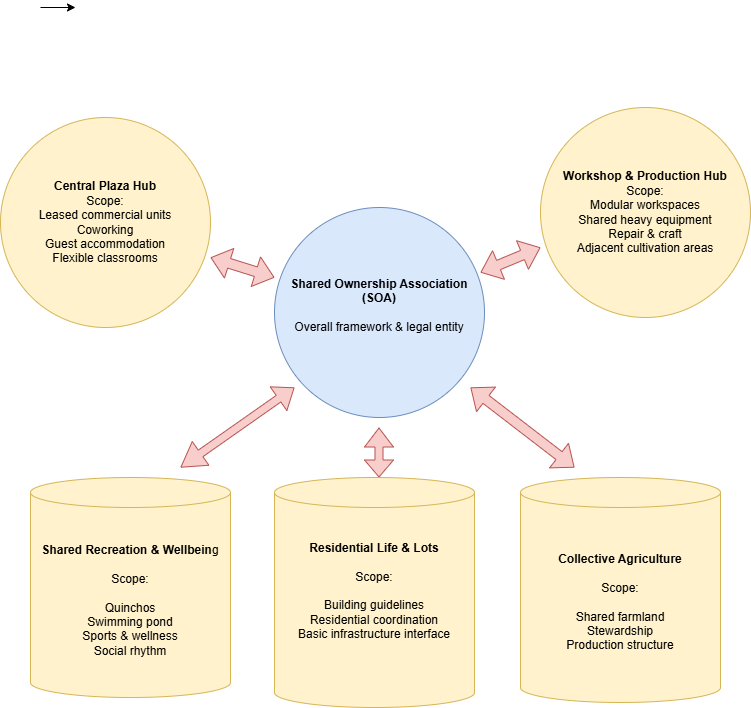
The Shared Ownership Association uses a sociocratic circle structure.
This means:
- Decisions are made within defined domains (pillars and hubs)
- Each circle has a clear scope
- Delegates connect circles to maintain alignment
The goal is not consensus on everything, but clear responsibility and feedback loops.
This prevents centralization of power and avoids constant general assemblies.
Transition of Control
During early phases, the founding team supports setup and coordination.
As the project becomes operational, governance transitions fully to the Shared Ownership Association.
End state:
- Owners manage shared matters
- Agreements are maintained collectively
- No permanent founder authority
In Short
- You own your land
- You opt into shared rules knowingly
- Agreements follow the land
- Conflicts are resolved proportionally
- Governance remains distributed
GranjaLotes is designed for people who value freedom with responsibility.
A prototype for territorial opt-in governance.